
Necessary
Required for security, core site functions, and storing your privacy choices.
Details
These technologies cannot be switched off because the website cannot function safely without them.
The question behind this book came from my own life. For years, I lived with labels, changing explanations and questions about my own behavior that did not always produce one clean answer.
That experience gave me the question. It did not give me the answer.
The gap between intention and behavior attracts explanations quickly: procrastination, fear, habit, self-sabotage, lack of discipline. Sometimes one fits. Sometimes several forces matter. Sometimes the explanation arrives before we have looked closely enough at what actually happened.
HumanTangle: What Pulls Us goes further than my experience. It investigates what can shape a choice when intention alone does not explain it, using research, documented cases, context, competing explanations and responsibility without pretending every pattern has one hidden cause or that understanding automatically makes change easy.
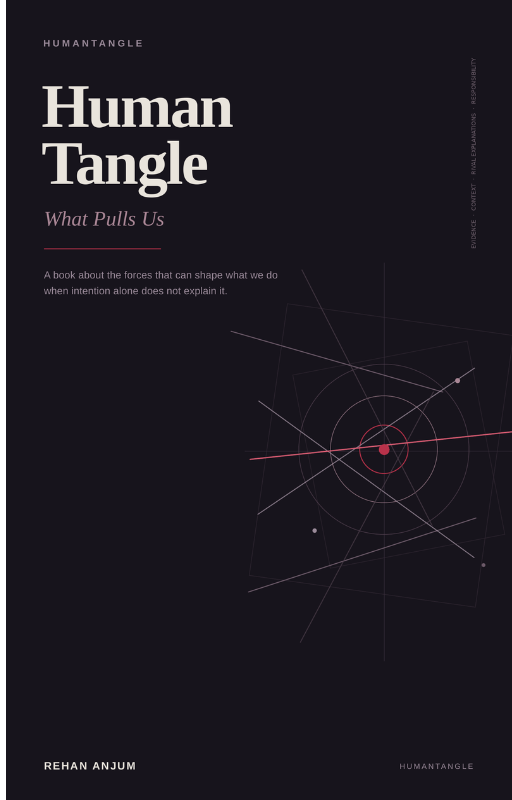
HumanTangle: What Pulls Us is its flagship book.
Someone keeps postponing something important, so the explanation becomes procrastination. Someone stays with what is familiar, so the explanation becomes fear of change. Someone keeps returning to the same behavior, so the explanation becomes habit. Someone defends a belief after encountering evidence against it, so the explanation becomes bias.
Those explanations may matter, and sometimes one may be enough. But naming the visible pattern does not automatically tell us why it happened in that particular case. Immediate relief may matter. Repetition may matter. Uncertainty may matter. Other people may matter. What someone already believes may matter. Real constraints may matter. Choice and responsibility may still matter too.
The simpler explanation is allowed to win as well. The person may have forgotten, discovered that the alternative cost too much, dealt with something more important, changed their mind or simply made a poor choice. Human behavior does not become clearer merely because more psychology is added to the explanation.
The useful question is which explanation actually survives contact with what happened.
Take someone who has been saying for a year that they want to leave a job but never leaves. You might conclude that they clearly do not mean it.
Then you learn that the job pays for their family’s basic needs, their savings are thin, the available alternatives are worse and the risk of leaving lands on more than one person. The behavior did not change. The quality of the explanation did.
Now imagine they receive a strong alternative offer and still remain where they are. The question changes again. Maybe stability matters more than they admitted. Maybe the current job gives them something they value. Maybe the alternative carries a cost you do not know about. Maybe they simply made a poor decision.
You do not have to insist on five explanations when one will do. You only need to resist pretending you know which explanation is true before you have enough reason to choose it.
Your own patterns deserve the same honesty. If you keep saying one thing while repeatedly doing another, the behavior should make you curious. It may expose a priority you have refused to admit, a constraint you keep ignoring or an intention that changes more easily than you thought. It may show that you sincerely care about the outcome and have built almost nothing around that care. It may simply show a series of choices you need to stop defending.
Instead of declaring the earlier intention a lie, ask what actually happened. What exactly did you want? Did the intention remain stable? What else was competing for the same resources? What place did the goal hold when the decision arrived? Was the action still reasonably available? Did another responsibility deserve to win? Did you knowingly choose against something you still valued?
Those questions are harder to hide from than “I need more motivation.” The point is not to make every contradiction mysterious. It is to stop purchasing certainty too cheaply.
The same outward behavior can make sense for different reasons. HumanTangle: What Pulls Us examines several factors that may matter before deciding what actually explains a particular case.
Something can make the next few minutes easier while making the longer-term problem worse. The long-term intention may still be sincere.
Familiar does not automatically mean safe, good or preferred. Sometimes it is simply easier to predict, and changing course can carry real costs of its own.
Not knowing can change how long we hesitate, what information we look for and how strongly we try to regain a sense of control. It does not explain every difficult decision.
Repeated behavior can become easier to initiate in familiar contexts. That does not make every repeated action a habit, and habit does not mean choice has disappeared.
Choices do not happen in isolation. Other people can provide information, establish expectations, affect belonging, help coordination or change what feels costly to resist.
What we already believe can influence how we interpret what comes next. Real constraints can narrow available choices too, while the question of responsibility still has to be examined rather than assumed away.
The book examines relief, familiarity, uncertainty, repetition, social influence, self-concept and defensive reasoning, then turns the same standard back on itself.
Those ideas are not hidden switches inside everybody. A particular behavior may involve one of them, several of them, or none of them in the way we first expect. HumanTangle does not convert them into percentages, produce a personality score or offer a test claiming to reveal somebody else’s private motive.
HumanTangle: What Pulls Us is not built around one theory of why people behave the way they do. Sometimes several forces remain relevant. Sometimes the explanation becomes narrower. Sometimes the explanation that initially sounded most interesting has to be rejected. And sometimes part of what happened remains uncertain.
There is no reason to preserve a HumanTangle explanation when a simpler explanation fits the evidence better. The aim is to explain only as much as the evidence supports.
This is not therapy, diagnosis or medical treatment. It is not a personality test, motivational manifesto or system claiming that one method will change everyone.
The book does not assume trauma explains everything, reduce distraction to dopamine, turn every delay into self-sabotage, call every repeated behavior a habit or explain every struggle as a lack of discipline. It also does not claim access to another person’s private motive merely because their behavior has been observed.
Understanding something does not automatically make changing it easy. The promise is smaller than that, but more useful: a better way to examine what may actually be shaping a behavior before settling on the explanation.
Hypothetical examples can make an idea easier to understand, but they are not enough on their own. Throughout the book, documented research and real decisions are used when they can test an explanation rather than merely decorate it.
A real habit-formation study shows why one universal number of days cannot tell everyone when a habit has formed. Research at Princeton shows students misjudging how comfortable their peers actually were with campus drinking practices, revealing how a mistaken picture of the group can become part of a person’s social environment. A famous story long associated with cognitive dissonance is reopened when newer archival research challenges what the original account said happened.
Elsewhere, a workplace savings program provides a documented example of voluntary precommitment. The decision preceding the Space Shuttle Challenger launch is examined through the official investigative record, allowing the book to separate what the evidence establishes from psychological motives we would have to invent.
These cases are not included because famous stories make a book sound impressive. They are there because an explanation becomes more useful when reality is allowed to challenge it.
HumanTangle begins with the question, not with a theory it has already decided to prove. Research from psychology, behavioral science, cognitive science, sociology, decision science and other relevant fields may help explain a pattern, but the source matters only if the claim made from it remains proportional to the evidence.
Where findings are mixed, limited, dependent on context or unable to establish a particular person’s private motive, those limits remain visible. Documented real-world cases receive the same treatment: the book separates what the record establishes from the psychological story someone might be tempted to place over it.
Research is not treated as a collection of impressive studies to stack behind an argument. A finding has to help explain the question in front of us, and competing explanations still have to be considered.
The book includes chapter-grouped Source Notes behind material research claims so the evidence can be inspected without turning the reading experience into citation clutter.
The aim is not to make human behavior sound scientific. It is to make the explanation more defensible.
The point is not to memorize a list of forces and start attaching them to every behavior you see. It is to become slower about the explanation.
You may notice that immediate relief and long-term intention can exist at the same time, that repetition is not automatically habit, and that familiarity can matter without meaning something is good or secretly preferred. You may become more careful about what uncertainty, other people, existing beliefs and real constraints contributed before deciding that somebody simply lacks discipline, confidence or responsibility.
The same caution applies to judgment. Visible agreement does not automatically reveal private belief, and understanding why somebody made a choice does not automatically excuse the choice. When several explanations seem possible, the useful task is to separate what was observed from what was assumed and see which explanation actually earns its place.
That does not guarantee change, but it can make the next question more accurate.
Near the end of the book, HumanTangle condenses the investigation into eight questions a reader can carry into a confusing pattern. They begin with what actually happened, separate observation from inference about motive, and ask what the competing choice offered, what had been repeated around the behavior, what remained unknown, what other people or constraints changed, and what rival explanation could fit the same evidence.
The final question asks what remains changeable now.
This is not a checklist that must be completed every time, and there is no score at the end. If one explanation already survives the evidence, there is no prize for making the situation more complicated. The questions exist to help an investigation stop in the right place, not to turn ordinary life into a permanent psychological analysis project.
Thirteen chapters move from the gap between intention and action toward a broader question of what actually shapes behavior.
HumanTangle: What Pulls Us is for readers who keep noticing gaps between what people intend, believe, say and actually do, and want better explanations than the first label that comes to mind.
It may be especially useful if you are curious about procrastination, repeated behavior, uncertainty, difficult choices, social influence, changing beliefs, responsibility or why understanding something does not always make acting on it easy. You do not need a background in psychology; the book is written for general readers willing to examine familiar behavior carefully without assuming every problem has one hidden cause.
This is not a clinical guide, diagnostic tool or substitute for professional care. It is also probably not the right book if you want one universal explanation for human behavior, a personality type that explains who you are, a motivational system built around discipline alone or a fixed sequence promising that change will follow if you perform it correctly.
If you are looking for a book that removes responsibility whenever circumstances matter, or ignores circumstances whenever choice remains possible, HumanTangle deliberately takes neither route.

Rehan Anjum is the founder of HumanTangle and the author of HumanTangle: What Pulls Us.
He wrote the book after years of living with questions about his own behavior and the explanations attached to it. His experience is part of why he cared enough about the question to investigate it, but it is not used as proof of what explains other people.
In the book, he examines ordinary questions about why people can genuinely intend one thing and still do another, testing familiar explanations against research, documented cases, context, rival explanations and responsibility.
Rehan writes and publishes independently through HumanTangle.com.
A digital book about the forces that can shape what we do when intention alone does not explain it.
The complete book includes 13 chapters, documented real-world cases, a compact eight-question reader field guide and chapter-grouped Source Notes behind material research claims.
PDF and EPUB are standard digital file formats. You need a compatible PDF reader and EPUB reader or device. No physical edition is included.
A private delivery link is issued after successful payment and remains available for 14 days. A legitimate delivery problem or expired link can be reviewed against the original purchase; expiry alone does not require a second purchase.
There is no subscription, course, recurring charge or additional knowledge tier required to complete what the book begins. The book is the complete purchase.
The book asks the larger question. The publication keeps investigating the individual patterns that sit inside it.
Why intention can lose when action arrives, and when familiar labels explain less than they seem to.
How goals, repetition, learned responses, immediate consequences and deliberate choice can meet in the same behavior.
What uncertainty, information, competing options and attempts to gain control can do to a decision.
How perceived risk, capability, standards and avoidance can shape what someone attempts, delays or leaves alone.
How closeness, belonging, expectations, dependence, conflict and real interpersonal costs can influence choices.
How judgments about ourselves can form, persist and affect behavior without turning every difficulty into an identity problem.
How prior beliefs, evidence, identity and social context can affect what we accept, reject or defend.
What can genuinely be changed, which constraints matter, where agency remains, and why explanation and excuse are not the same thing.
HumanTangle is an independent publication about recurring human patterns and the forces that can shape thought, behavior, choices, relationships, beliefs and consequences.
Psychology is one source of evidence, not the boundary of the publication. Depending on the question, HumanTangle may also draw from behavioral science, cognitive science, sociology, economics, decision science, history, philosophy, institutional research and documented real-world evidence.
The aim is consistent across all of it: understand the pattern without reducing the person to the pattern.
Human behavior can look simple from the outside, and sometimes the simple explanation is the right one. The difficulty begins when an explanation arrives before the case has been examined closely enough.
HumanTangle exists to keep asking what actually matters in that case, including the evidence, context, alternatives, constraints and choices that remained. It applies the same standard to its own explanations.
We use optional technologies only when your choices allow them. You can accept, reject, or choose by category.
We use optional technologies only when your choices allow them. You can accept, reject, or choose by category.
Required for security, core site functions, and storing your privacy choices.
These technologies cannot be switched off because the website cannot function safely without them.
Optional features that remember non-essential choices and personalization.
Helps the site owner understand visits and improve the website.
Used for advertising, retargeting, and measuring campaigns.
Loads media hosted by third parties, such as video platforms.